Washing hair is a trade, and it is worth being honest about the terms. Every good wash removes what you wanted gone — sweat, styling residue, excess oil at the roots — and takes a little of what you needed with it. What it takes is lipid: the thin layer of oils that keeps the surface of the strand smooth, flexible and sealed. Understanding that trade is the whole logic of a nourishing ritual.
What does washing take from hair besides dirt?
The scalp produces sebum — a natural blend of oils that coats each strand at the root and, in theory, travels down its length. In practice, on anything longer than short hair, sebum rarely makes the full journey: the mid-lengths receive little and the ends almost none, which is why ends are always the driest, roughest part of any head of hair. Washing then works on top of this uneven supply. Surfactants cannot tell excess oil at the roots from the scarce lipid film along the lengths, so both leave with the rinse water. Harsh sulfates take the most — that squeaky after-wash feel is the sound of a stripped surface — which is why a nourishing ritual starts with mild, plant-derived surfactants rather than trying to out-condition an aggressive cleanse.
What do butters and oils actually do on a strand?
Two jobs, both mechanical. First, emollience: oils fill the microscopic gaps between cuticle scales, smoothing the surface so strands slide over each other instead of catching. That is where softness, shine and easier detangling come from — less friction, less snagging, fewer split ends started by combing. Second, occlusion: a fine film of lipid over the cuticle slows the escape of water from inside the strand. This is the quiet partnership with hydration — humectants pull water in, lipids keep it there — and it is why lipid care and moisture care belong in one system rather than in competition.
What makes argan oil more than a trend?
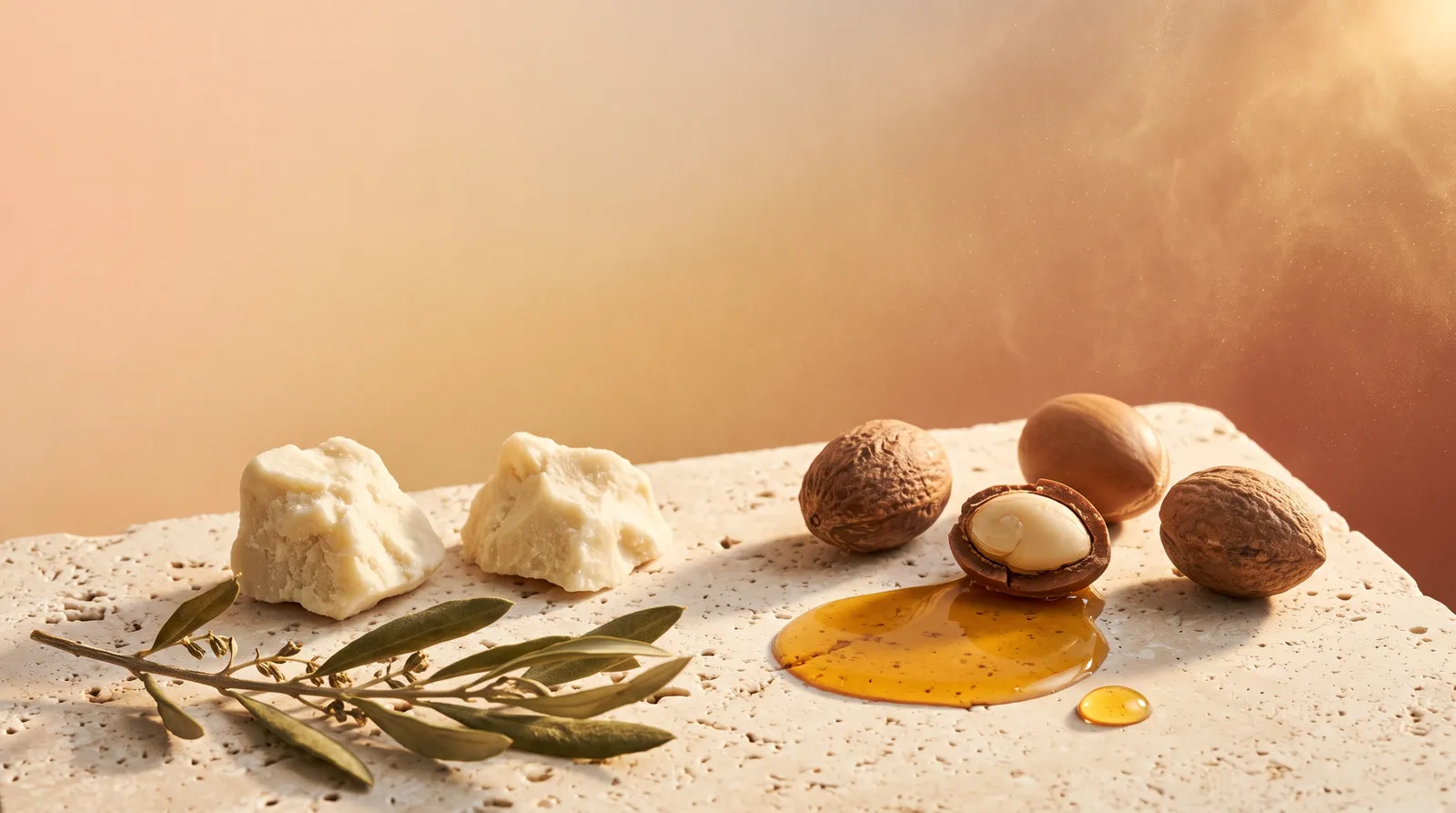
Argan has been fashionable long enough to invite suspicion, but its case rests on composition, not marketing. It is rich in vitamin E, an antioxidant, and oleic acid, a fatty acid whose value here is the character of the film it forms: flexible. Around the cuticle, that film moves with the hair instead of stiffening it, slows water loss, and shields color pigment from oxidation — the slow chemical fade that washing and light inflict on every color service. The practical effect is simple: color that stays vibrant longer between washes.
What does shea butter add that an oil cannot?
Shea is the heavier half of the pair. Where argan is a fluid oil that spreads thin and disappears into the surface, shea is a butter: denser, slower and rich in emollients — better suited to the driest, most porous stretches of hair, the ends above all. The risk with any butter is weight, and this is a question of dose rather than ingredient: in the No. 05 series both are formulated at percentages that nourish without coating, so the richness reaches the strand without flattening it.
Who suits rich textures — and who should go lighter?
Lipid-rich care earns its keep where lipids are shortest: color-treated hair first — the series was built to extend color life, and after any color service the routine starts 48 hours later, once the cuticle has closed — then coarse, curly and visibly dry hair, whose geometry makes sebum’s journey down the strand hardest. Fine hair is not excluded; it simply needs the dose logic — lighter steps daily, the rich mask weekly rather than constantly. Low-porosity hair, which absorbs slowly, benefits from a weekly pairing with the No. 01 Hyaluronic Acid mask, so water arrives before the lipid film seals the surface. And for color-treated hair the cleansing base is non-negotiable: sulfate-free, because a harsh surfactant would strip in one wash what the oils spend a week restoring.
How do you run a lipid ritual?
The shape is familiar: a mild daily wash and conditioner to clean without stripping, the rich mask weekly for the deep replacement work, and the serum on lengths and ends — precisely the territory the scalp’s own oil never reaches. Roots need the least; ends need the most; the ritual simply follows the map of scarcity.
Washing subtracts lipids on schedule, and hair has no way to put them back on its own. A nourishing ritual is not indulgence — it is the replacement schedule.
None of this is exotic. Butters and oils are the oldest ingredients in hair care because the problem they solve is permanent: the surface of the strand needs a lipid coat, and modern washing removes it faster than nature restores it. Argan and shea, chosen well and dosed carefully, simply put back what the trade took.